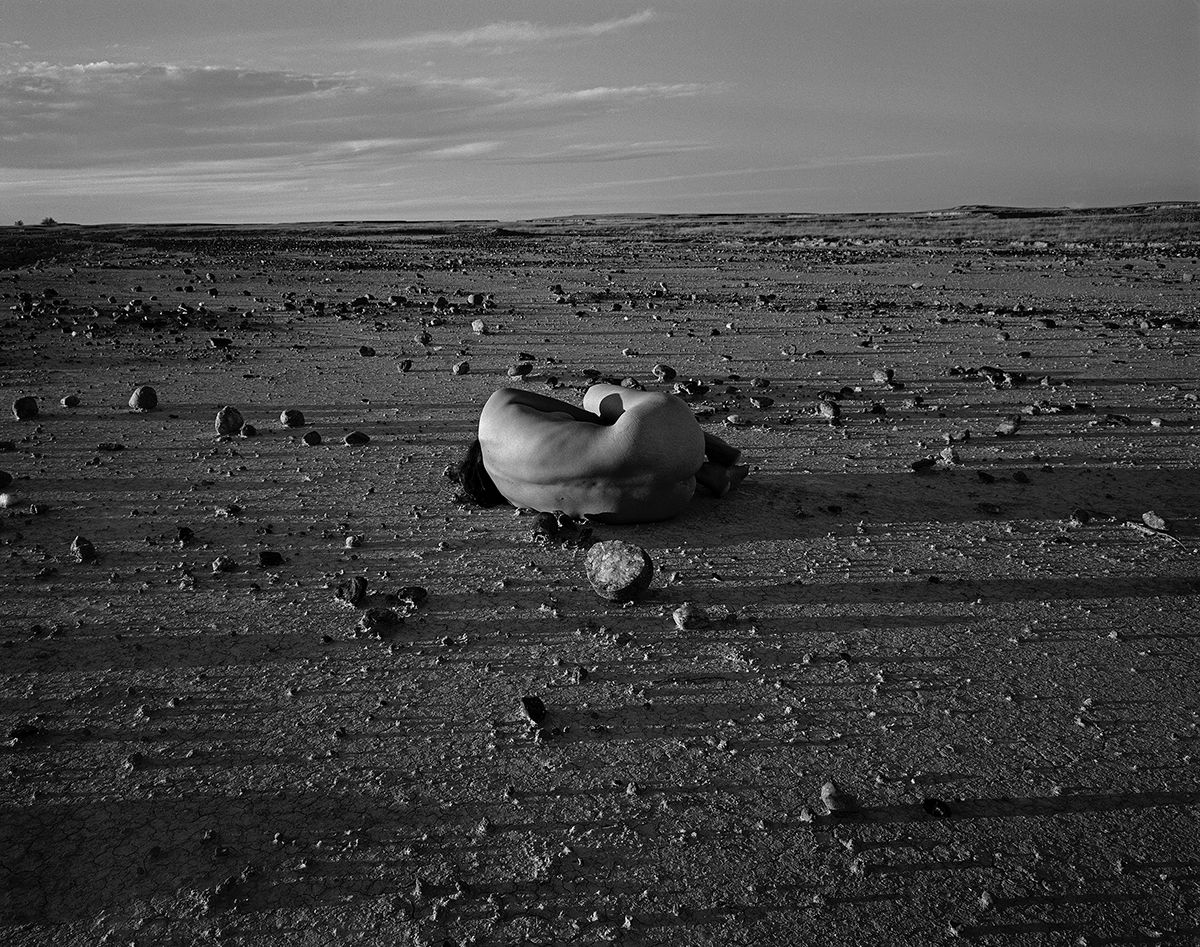
In this 1981 self-portrait, Judy Dater poses in the Badlands of South Dakota. “I think the black-and-white self-portraits in the landscape were really about finding something interior about myself,” she said. (Judy Dater Photograph Archive, BANC PIC 2025.036, The Bancroft Library)
As a child, Judy Dater was afraid of the dark.
On Saturday mornings, she accompanied her father to the movie theater he owned in Hollywood. While he worked in his office, Dater challenged herself to venture deep into the pitch-black auditorium—far enough to touch the stage—then sprint back down the aisle to safety.
“It took me a long time until I finally had the nerve to do it,” she recalled in a recent interview in her light-filled Berkeley studio. “But I did it.”
She discovered movies early and quickly fell under their spell—their sights, sounds, and stories. Dater was especially drawn to Westerns, with rugged cowboys and stallions galloping across the silver screen.
“For years, I just went like a happy sponge,” Dater said. “It didn’t matter what it was, I liked it.”
In high school, she worked as a cashier at the theater, catching snippets of films during breaks. Sometimes, she would head up to the projection booth to watch from above the audience, mesmerized by the magic and mystery of black-and-white images.
For more than half a century, Dater has built a career making photographs and telling stories with shadow and light. The Bancroft Library at UC Berkeley has recently acquired her archive, which traces her life through letters, books, diaries, drawings, and images. Blurring the boundary between documentary and fine art, her photographs offer an intimate view of the people and places she has encountered, guided by an artistic vision entirely her own.
“Judy Dater has photographed so many different kinds of people from all walks of life—these pictures allow people to get a true sense of who they were,” said Christine Hult-Lewis, Bancroft’s curator of pictorial collections. “Her photographs reveal something that is not easy to capture.”
A life in photographs
Dater’s interest in art began early.
Her parents took her to museums, and she developed an appreciation for painting, drawing, and sculpture. By junior high, she was drawing cartoons for her school yearbook and taking classes at an art college.
Dater’s collection reaches back to her childhood and young adult years. Early materials in the archive include collages, life drawings from her college years, her teenage diary transformed into an art piece, and old family photographs of relatives from Russia and Poland.
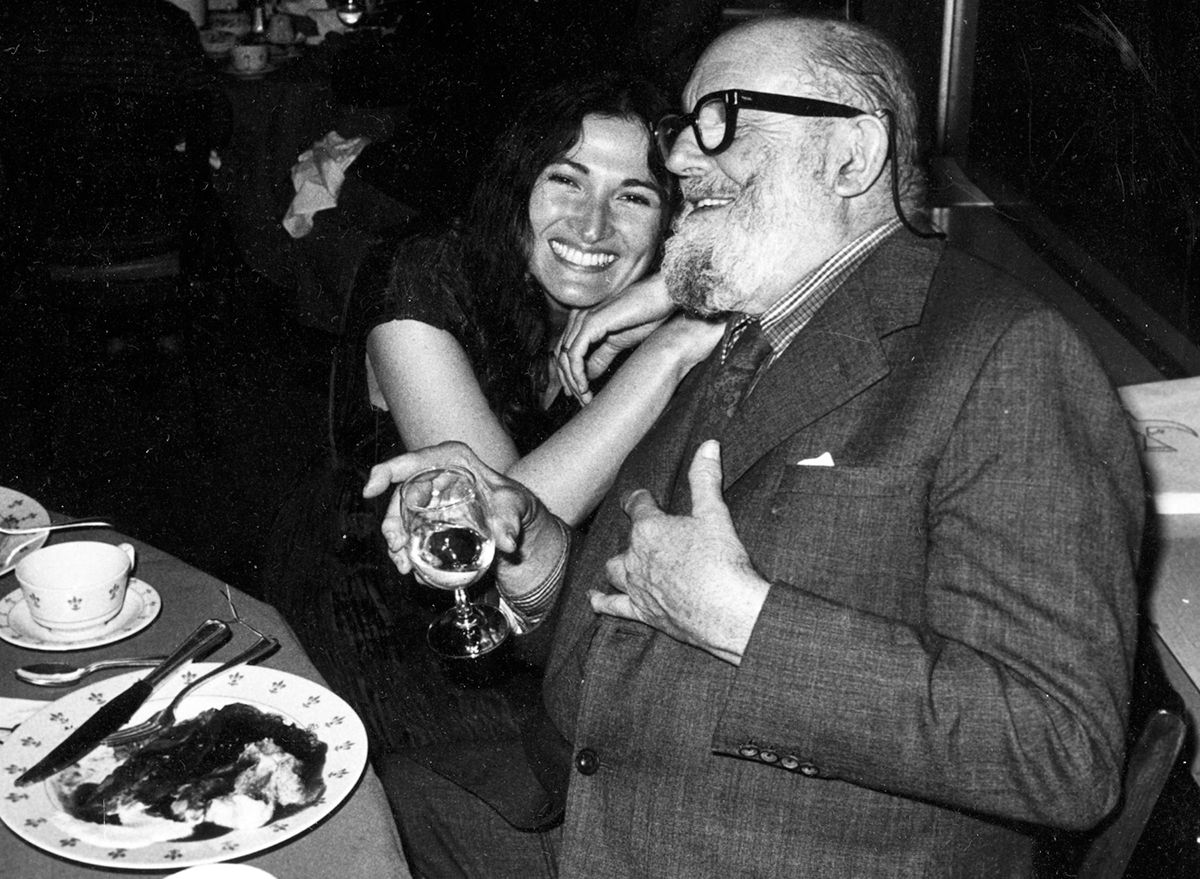
Dater and Ansel Adams beam in this image from his birthday party circa 1977. (Photo from the Judy Dater Photograph Archive; photographer unknown; BANC PIC 2025.036, The Bancroft Library.)
After high school, Dater followed her passion and studied art at UCLA. She moved north in 1962, enrolling at San Francisco State University to complete her studies. There, she took a job helping with registration, handing out class cards — the pre-digital tickets used to enroll in courses. Knowing how coveted the seats were, Dater secured a spot in her first photography class by taking a card for herself. It was the second semester of her senior year.
“The minute I started photography — right away — I knew this is it,” Dater said.
She earned her bachelor’s and master’s degrees at San Francisco State, and her graduate thesis is included in her collection at Bancroft.
As a student in San Francisco, Dater encountered some of the luminaries of the flourishing West Coast photography scene. She remembers class visits to the homes of photographers Brett Weston and Wynn Bullock, who dispensed generous wisdom and critiqued students’ work. Ansel Adams would have the students over for 5 o’clock cocktails, show them his darkroom, and regale them with stories. Over his fireplace hung a giant brass gong, which he would bang when it was time for guests to leave.
“It was to die for,” Dater said. “I was so incredibly lucky to have that experience as a young student. These extraordinary people were role models who gave us a path forward.
“They made it seem possible to choose photography as a life pursuit.”
Dater’s collection holds correspondence from Adams and Weston (who enclosed a pine twig in one letter), as well as other West Coast photographers such as Minor White and Imogen Cunningham.
Dater met Cunningham by chance. The two were at Big Sur Hot Springs, now Esalen, where Cunningham was a panelist at a conference celebrating the life and work of photographer Edward Weston. Cunningham saw Dater, then in her early 20s, wandering around and asked if she could take her photograph. In the resulting image, preserved in the archive, Dater has a plaintive look, her hair piled high on her head. After meeting in Big Sur, the two women kept in touch. Cunningham became a mentor and a friend — and in 1974, a subject in Dater’s best-known photograph.
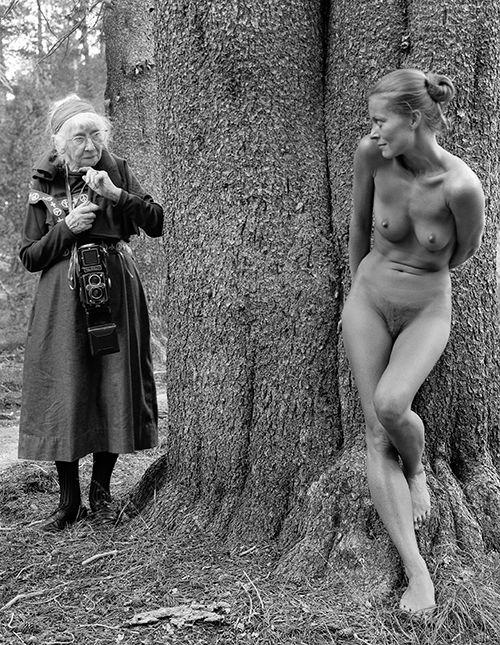
Taken in 1974, Imogen and Twinka at Yosemite became the first full-frontal nude to appear in Life* magazine. (Judy Dater Photograph Archive, BANC PIC 2025.036, The Bancroft Library)*
In Imogen and Twinka at Yosemite, Cunningham—90 at the time—peers out from behind a redwood tree to find a nude, nymphlike Twinka Thiebaud looking back at her, their gazes meeting in an evocative exchange. As Dater recalled, the now-iconic image was the last in a series she made while demonstrating for a workshop she was teaching.
The photograph is richly layered, drawing from a deep well of art and photographic history. Cunningham, born in 1883, was a pioneer in a male-dominated field and one of the women in Group f.64, a collective of Bay Area photographers known for capturing California’s untamed beauty. Thiebaud, the youthful model—resembling a wood sprite—is the daughter of the celebrated painter Wayne Thiebaud.
“The photograph gestures to universal truths about nature, about women, and about youth and old age confronting one another,” Hult-Lewis said. “When you dig a little more and learn the identities of these people, it deepens the whole experience. But it’s also a wonderful image on its own.”
Dater remembers seeing Persephone as a child in a book of great American paintings on her family’s coffee table. The photograph takes visual cues from Thomas Hart Benton’s artwork, which portrays an old farmer stealing a peek at a naked Greek goddess. Dater’s image replaces the male gaze with a shared moment between women.
Lauren Kroiz, an associate professor in the History of Art Department, counts the photograph among her favorites of Dater’s, noting the “playful way it intervenes in a feminist photographic history that is both local and global.”
In 1976, the photograph became the first full-frontal nude to appear in Life magazine.
“The nudity is important, but it’s not about that,” Dater said. “It really says something about women’s connection.”
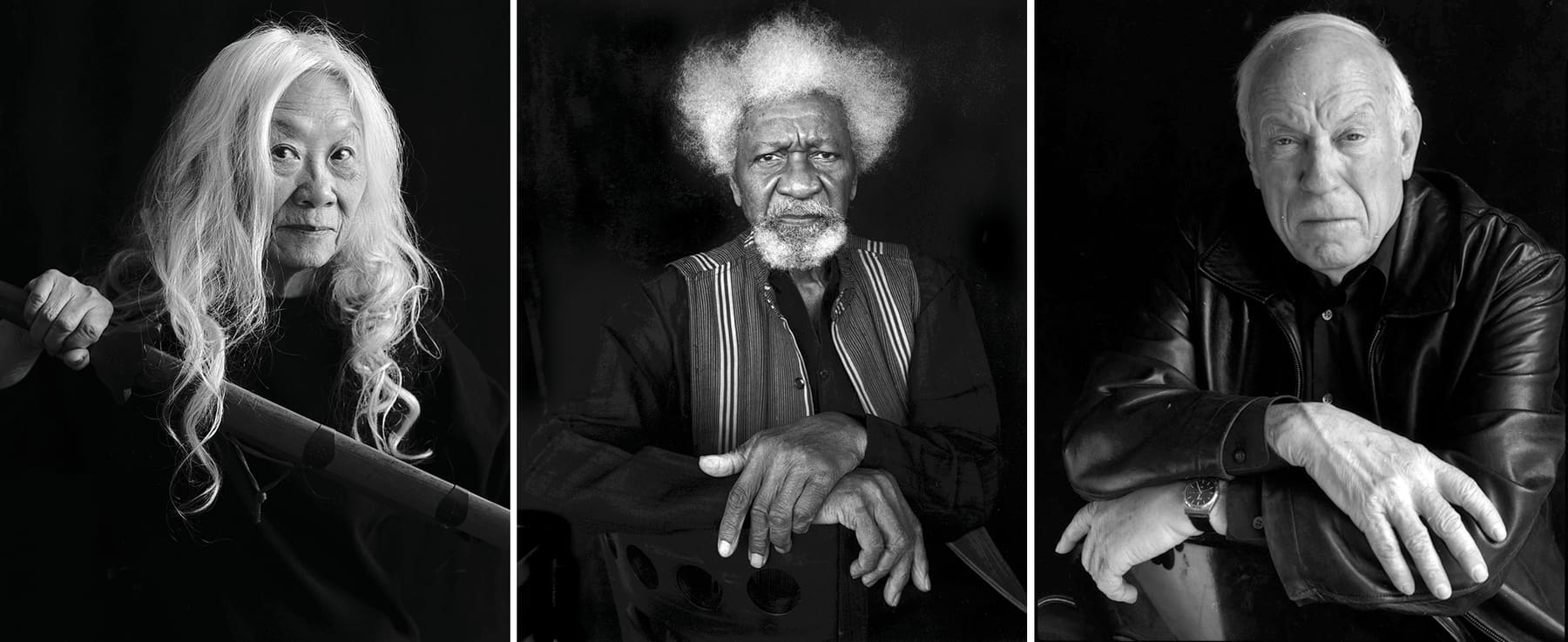
Writers Maxine Hong Kingston (left) and Wole Soyinka (center), and UC Berkeley professor Leon Litwack are among the many luminaries who have sat for Dater’s portraits. (Judy Dater Photograph Archive, BANC PIC 2025.036, The Bancroft Library)
Imagery and empathy
If there is an invisible thread running through all of Dater’s photographs, it is empathy.
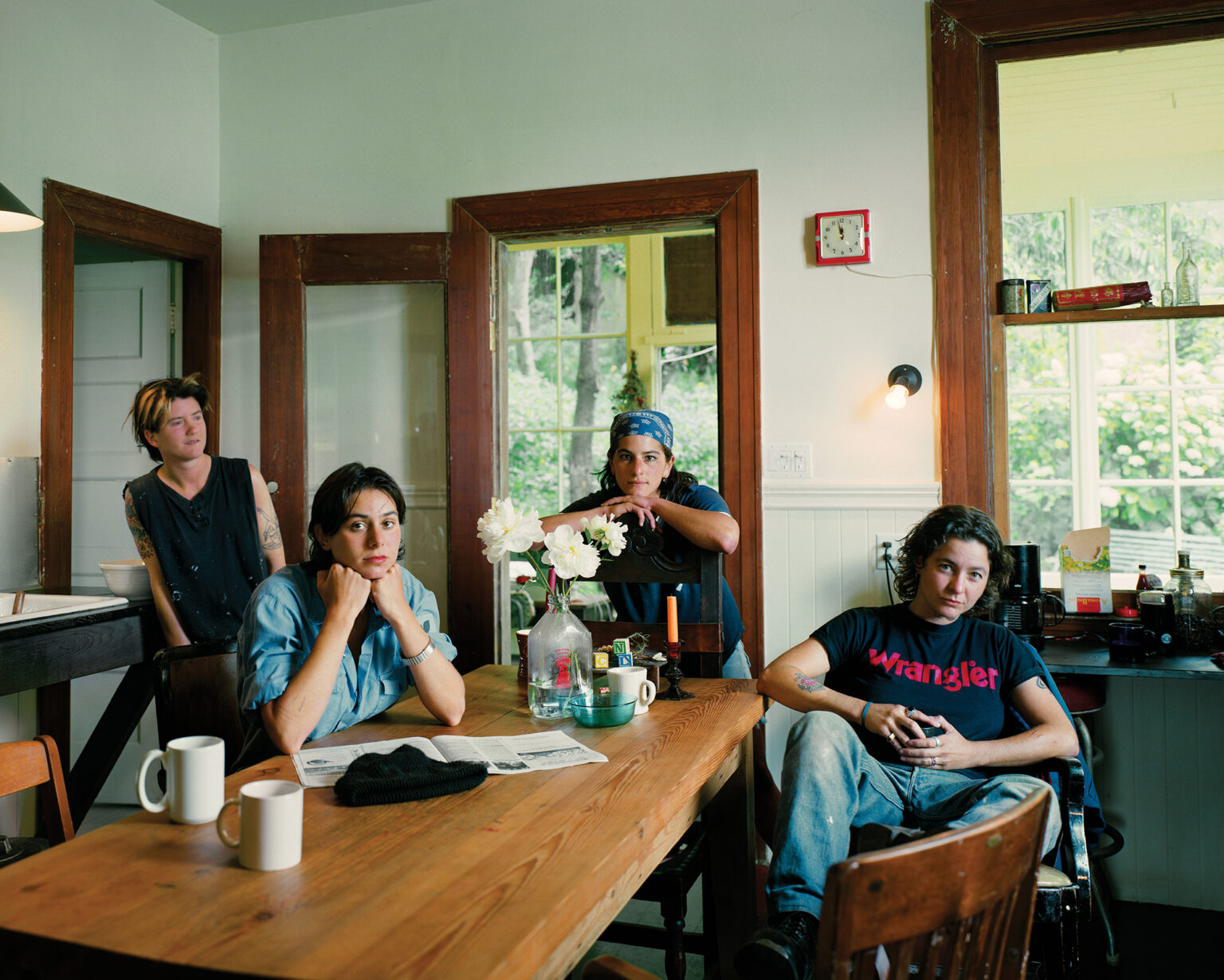
In each of Dater’s portraits of Maxine Hong Kingston—a UC Berkeley alum and professor emerita—she brings out a different side of the celebrated author. In one, Kingston plays with her hair, wearing an impish expression. In another, she holds a sword, evoking the spirit of her 1976 book, The Woman Warrior. By preserving whole sequences from each sitting, the archive offers a rare view of an artist at work, including alternate takes alongside Dater’s best-known images.
In a more recent project, Dater photographed Bay Area residents posing with their guns. The intimate pictures in The Gun Next Door are paired with narratives written by the subjects—including members of the LGBTQ+ community and a retired epidemiologist—complicating assumptions about who owns firearms and why.
A major part of Dater’s job, though, is to put people at ease. At the back of her studio, soft light pours through floor-to-ceiling windows. Cream-colored parlor chairs sit before a black backdrop, opposite an old wooden Deardorff camera. The 1972 field camera—a classic with a conspicuous presence—serves as an icebreaker, Dater said, and is central to her “trust machine” for making portraits. She connects with each subject, listens to their stories, helps them relax, and guides them through each frame. “People like to be appreciated,” she said. “They like to be heard.”
With her portraits, Hult-Lewis said, Dater creates images that are not only beautiful to look at, but that also use light, darkness, shape, and form to capture something deeper.
“It’s like looking into their soul, and using art to bring out the innermost person,” Hult-Lewis said.
At the moment, Dater is working on a series of portraits of Black luminaries, including former UC Berkeley professor and vice chancellor Russ Ellis, historian Henry Louis Gates Jr., artist Mildred Howard (whose archive Bancroft has recently acquired), and philosopher and activist Cornel West. Once the project is complete, it will join the collection at Bancroft.
Dater’s archive adds to Bancroft’s trove of materials that bring the history of the American West to life. Once processed—a task that can take a couple of years—the collection will be open to anyone who wants to learn about Dater’s life and work, and her place in photographic history.
The archive will outlive her, with the potential to inspire future photographers, spark new insights, and, as Dater put it, unearth “some surprises and revelations.”
Her work speaks for itself, she said, and no two people will experience the same photograph in exactly the same way.
“I think the main thing is that artists want you to feel something, think about something, question something,” she said. “And as long as you get something from it, that’s what matters.”